.png)


Hotel Guest Sentiment Analysis: Positivity, Impact and What to Fix First
%2520(1).png)
.png)
Hotel guest sentiment analysis tells you how guests feel about each part of their stay. On its own, it doesn't tell you what to fix first. That takes four measures read together: mentions, Positivity Score, Impact Score and Chance for Improvement. Sentiment analysis is one part of guest feedback intelligence, the wider practice of turning what guests say into fixes, investments and a better next stay.
What is hotel guest sentiment analysis?
Hotel guest sentiment analysis is the process of reading guest reviews and survey comments at scale to find which topics guests mention and whether they mention them positively or negatively. Done well, it goes past positive and negative labels. It shows which specific topics are raising or lowering your rating, at which properties, and in which rooms.
Most tools sort feedback into standard categories such as rooms, housekeeping, front office and F&B. That is a useful starting point, but categories are too broad to act on. "Rooms scored badly this month" does not tell a maintenance team what to do on Monday morning.
The more useful approach starts from what guests actually write. In MARA's review analytics, the AI first extracts hotel-specific topics in the guest's own terms, then places them under categories and subcategories. A topic can be as specific as "poor air conditioning", "absence of slippers in the room" or a ''lack of vegan options''. Those are problems someone can own and fix.
{{blog-cta-book-demo="/features/product-updates"}}
Where does sentiment analysis fit in guest feedback intelligence?
Guest feedback intelligence is the practice of bringing together every piece of guest feedback and using it as an operational data source, not only a reputation metric. It runs from collecting feedback to understanding it, acting on it and deciding where to invest.
Sentiment analysis is the understanding part: it shows what guests are saying at scale. The rest of this article covers how to measure it, and how it connects to fixing issues and making investment decisions.
For examples from operators already working this way, including Clink Hostels and Capilon Hotels, read how the UK's most forward-thinking hospitality operators are using guest feedback differently.
Why doesn't sentiment alone tell you what to fix?
Sentiment, which MARA measures as the Positivity Score, shows how often a topic is mentioned positively or negatively. It does not show whether that topic changes how guests rate their stay. Two topics can have the same Positivity Score and completely different effects on your rating, so ranking by sentiment alone sends teams after the wrong problems.
Here is the pattern we see in hotel reviews. Several guests mention that the cushions were too hard, yet they still give five stars. The comment is negative, but it is not costing you anything. Meanwhile, guests who are unhappy with housekeeping give noticeably lower ratings. Both topics have a low Positivity Score. Only one has a negative Impact Score.
Volume misleads too. The topic mentioned most often is not necessarily the one costing you rating. Breakfast might appear in half your reviews with little effect on scores, while a noisy air-conditioning unit comes up less often but almost always alongside a low rating. The useful measure weighs both: how much a topic hurts, and how often it comes up.
This matters beyond the operations meeting. When a GM asks an owner to fund a refurbishment, "the Positivity Score for rooms is down" is hard to defend. "Reviews that mention shower pressure score well below our average, and most come from one wing" is a case someone can approve.
Your guests are already telling you what needs to change. The question is whether your tools separate the complaints that move your rating from the ones that don't.
Positivity Score vs. Impact Score: what's the difference?
The Positivity Score is MARA's sentiment measure: the share of reviews mentioning a topic that are positive. The Impact Score combines two things: how far the average rating of reviews mentioning a topic sits above or below your overall rating, and how often that topic comes up. Positivity tells you how guests feel. Impact tells you what that feeling is doing to your MARA Score.
For example, if reviews that mention the rooms average 0.4 points below your overall rating, and rooms come up in a quarter of all reviews, the Impact Score for rooms is −0.4 × 0.25 = −0.10. A topic that hurts a lot but rarely appears scores lower than one that hurts moderately and appears constantly. That weighting is what makes the score useful for ranking.
The practical rule: sort topics by Impact Score first, then use the Positivity Score and mentions to understand them. Chance for Improvement then shows the upside, meaning how much your MARA Score could rise if the negative mentions in that area were resolved. A topic with a strongly negative Impact Score and a high Chance for Improvement is your priority. A topic with a low Positivity Score but near-zero impact can usually wait.
What metrics should hotel sentiment analysis include?
Useful hotel sentiment analysis combines topic depth, rating impact and operational context. A single positive or negative score per category is not enough to decide what to change. When evaluating your own reporting, check that it covers these eight things.
- Topics at three levels. Categories such as rooms, housekeeping, F&B and front office for reporting, subcategories for ownership, and hotel-specific topics in the guest's own words for action.
- Mentions. How many reviews raise each topic, split into positive and negative mentions.
- Positivity Score. The share of positive mentions per category, subcategory and topic, read together with impact rather than instead of it.
- Impact Score. How much reviews mentioning each topic move your MARA Score up or down, weighted by how often the topic comes up, so you can rank problems by cost rather than by noise.
- Chance for Improvement. How much your MARA Score could rise if the negative mentions in an area were resolved.
- Change over time. Every metric compared against a previous period or the same period last year, so you can tell a spike from a baseline.
- Operational context. Room number, room type and rate behind each review where your PMS allows it, so complaints can be traced to a place.
- Source control and correction. The ability to view OTA reviews, surveys or both, filter by platform, and move a topic to a different category when the AI's grouping doesn't match how your team works. In MARA, reassigned topics stay in their new category from then on.
How do you track guest satisfaction trends over time?
Track guest satisfaction at topic level, not only as a rating line. Compare each period against the one before and the same period last year, review specific topics weekly, and review rating impact by category every quarter. A flat overall score can hide one topic getting steadily worse while another improves.
A cadence that works for most hotels:
- Weekly, in the team meeting. Look at the list of positive and negative topics from the past seven days. It is fast, specific and easy for housekeeping or front office to act on. MARA sends a summary of the previous week's top topics, response rate and rating every Monday, and a monthly version on the first Monday of each month.
- Monthly, with department heads. Filter topics by category, such as F&B or housekeeping, and send each team the part that concerns them.
- Quarterly, with leadership. Sort categories and subcategories by Impact Score and Chance for Improvement to see which areas are actually moving the MARA Score over a longer window.
One detail worth knowing: the live score on Booking.com or Expedia includes older reviews, so it moves slowly. The average rating of reviews received in a given month moves faster. Watching both tells you early which direction your public score is heading.
For teams that don't want to build these views by hand, MARA's AI Research Assistant turns the same analysis into scheduled reports. It works from MARA's structured review data (Positivity Scores, topic categories, Impact Scores and historical analytics), not just raw review text. A "What to Fix" report, for example, ranks the recurring complaints worth acting on. Reports arrive as a web page and PDF, recipients don't need a MARA login, and each report accepts follow-up questions such as "why did housekeeping scores decline?".
For quick questions between reports, Ask Reviews Anything lets you ask your reviews in plain language, such as "what do guests complain about at breakfast?". See the full walkthrough in the Mastery Series session on analytics.
How do you link guest sentiment to specific rooms?
Connect your PMS to your review analytics. When a review can be matched to its reservation, you see the room number, room type, rate and stay dates behind it. That turns "guests complain about Wi-Fi" into "guests complain about Wi-Fi on the third floor".
In MARA, the match uses the OTA reservation ID, so it works for Booking.com and Expedia reviews once both the PMS integration and the direct OTA integration are active. Roughly 95% of those reviews can typically be matched. Post-stay surveys can be matched too, if the reservation ID is passed in the survey link. Supported PMS integrations include Mews, Apaleo, Ibelsa, Protel, Oracle OPERA Cloud, Stayntouch, Guestline and ASA. LikeMagic, which isn't a PMS, connects the same way.
With that link in place, you can:
- Compare average ratings by room, room type or rate to find the rooms to assign last, or the ones due for attention.
- Click into a topic such as "rooms too small" and see which rooms and room types it comes from.
- Receive automatic maintenance and housekeeping tickets created from reviews, for example a clogged sink in a named room, pushed into tools such as Mews Tasks, Flexkeeping, Snapfix or HotelKit. This is where the loop closes: the issue gets fixed before the next guest checks in.
Room-level data also shapes investment, the last stage of guest feedback intelligence. Clink Hostels used room-type analysis in MARA to see that their 18-bed dorm drew the most negative reviews, while 4- and 6-bed ensuite rooms performed significantly better. That finding now shapes what they build in London and Amsterdam. Read the full Clink Hostels story.
Reviews usually arrive several days after checkout, so a review-based ticket may describe something already fixed. Route tickets through someone who can check first. The full setup is covered in the Mastery Series session on connectivity and integrations.
How do hotel groups compare guest sentiment across properties?
Hotel groups need one view that ranks every property on the same categories, with the ability to group properties by region or brand. The goal is to spot where one hotel is struggling on housekeeping while another in the same group gets it right, and then find out what the second one does differently.
In MARA's group overview, each category (rooms, housekeeping, F&B, front office and so on) becomes a column, and each property a row. You can switch the table between Positivity Score, Impact Score and MARA Score, sort it to find the weakest properties, and hover over any cell to preview the specific topics behind it.
Account admins can also create custom dimensions, such as region or brand, and assign properties to them. The whole analytics view can then be aggregated at that level, for example comparing the DACH region against Spain, or filtered to a single brand.
What to look for in hotel guest sentiment analysis tools
The best hotel guest sentiment analysis tools show which topics are changing your rating, trace them to rooms and properties, and deliver findings to the people who can fix them. Use these questions in any demo, including ours.
- Does it find topics in guests' own words, or only sort them into fixed categories? Ask to see the most specific topic it detected last month.
- Does it measure impact on rating, or only positive versus negative? Ask how it would rank a common but harmless complaint against a rare but costly one.
- Can it connect reviews to rooms, room types and rates? Ask which PMS systems it integrates with and which review sources can be matched.
- Does it analyse surveys and public reviews together, and let you separate them?
- Can your team correct the AI's categorisation?
- Can people outside the tool get the findings? Ask whether reports can be scheduled and sent to department heads without a login.
- Does it work at group level? Ask to see properties compared side by side, grouped by region or brand.
For a fuller vendor evaluation, download Hotel Tech Report's Reputation Management Software Buyer's Guide, which covers vendor comparisons and market trends. You can also read verified hotelier reviews in Hotel Tech Report's reputation management category.
How MARA approaches guest sentiment analysis
MARA is a reputation management platform for hotels and hotel groups, built around guest feedback intelligence. It collects reviews from Google, Booking.com, Tripadvisor, Expedia and other connected sources alongside MARA surveys, breaks every review into hotel-specific topics, and measures them with the MARA Score, Positivity Score, Impact Score and Chance for Improvement. The PMS integration traces issues to rooms, ticketing integrations send them to maintenance and housekeeping, and the Research Assistant delivers findings to the people who need them.
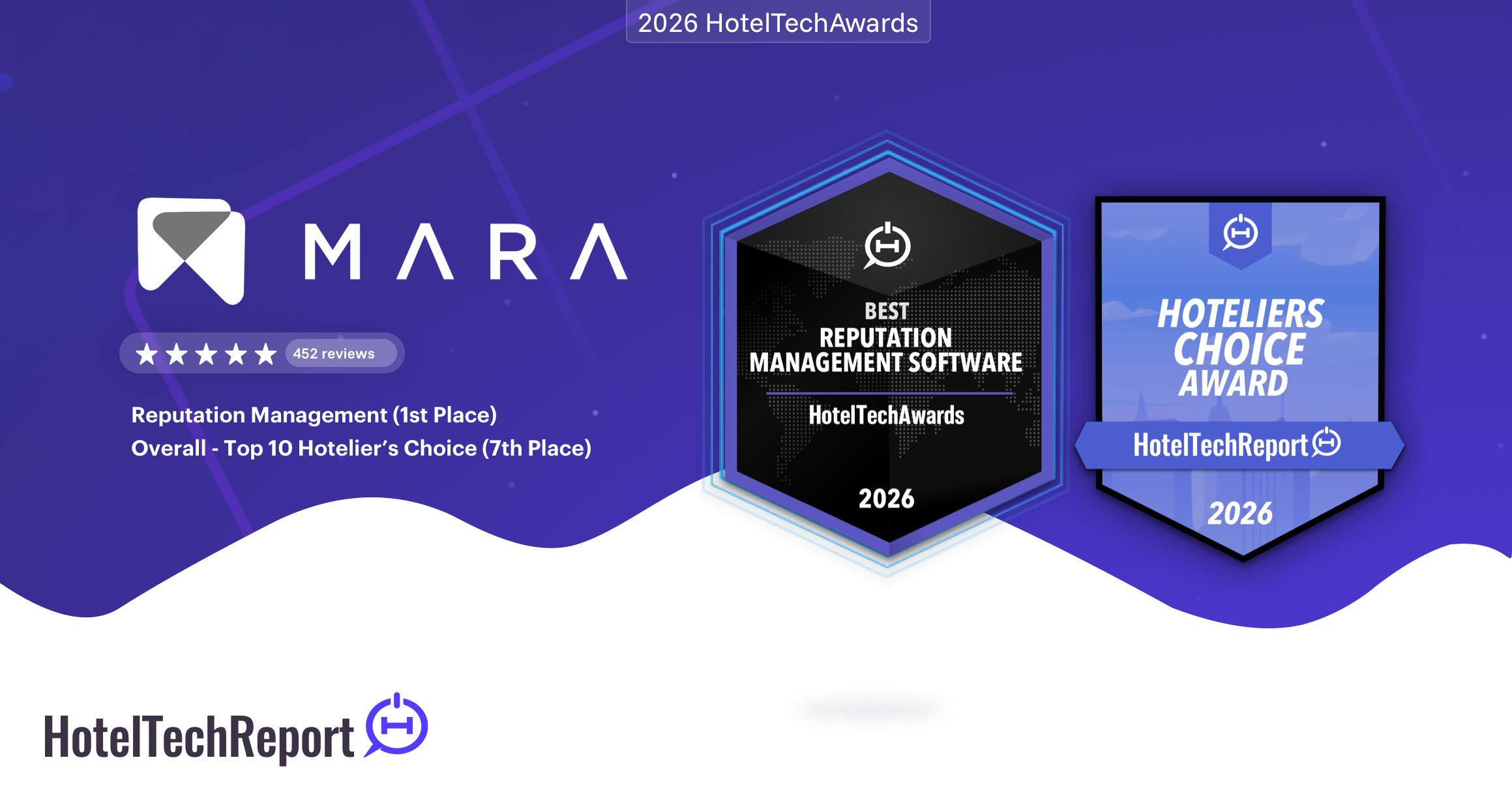
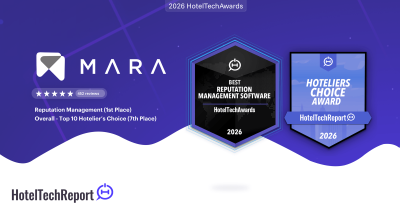
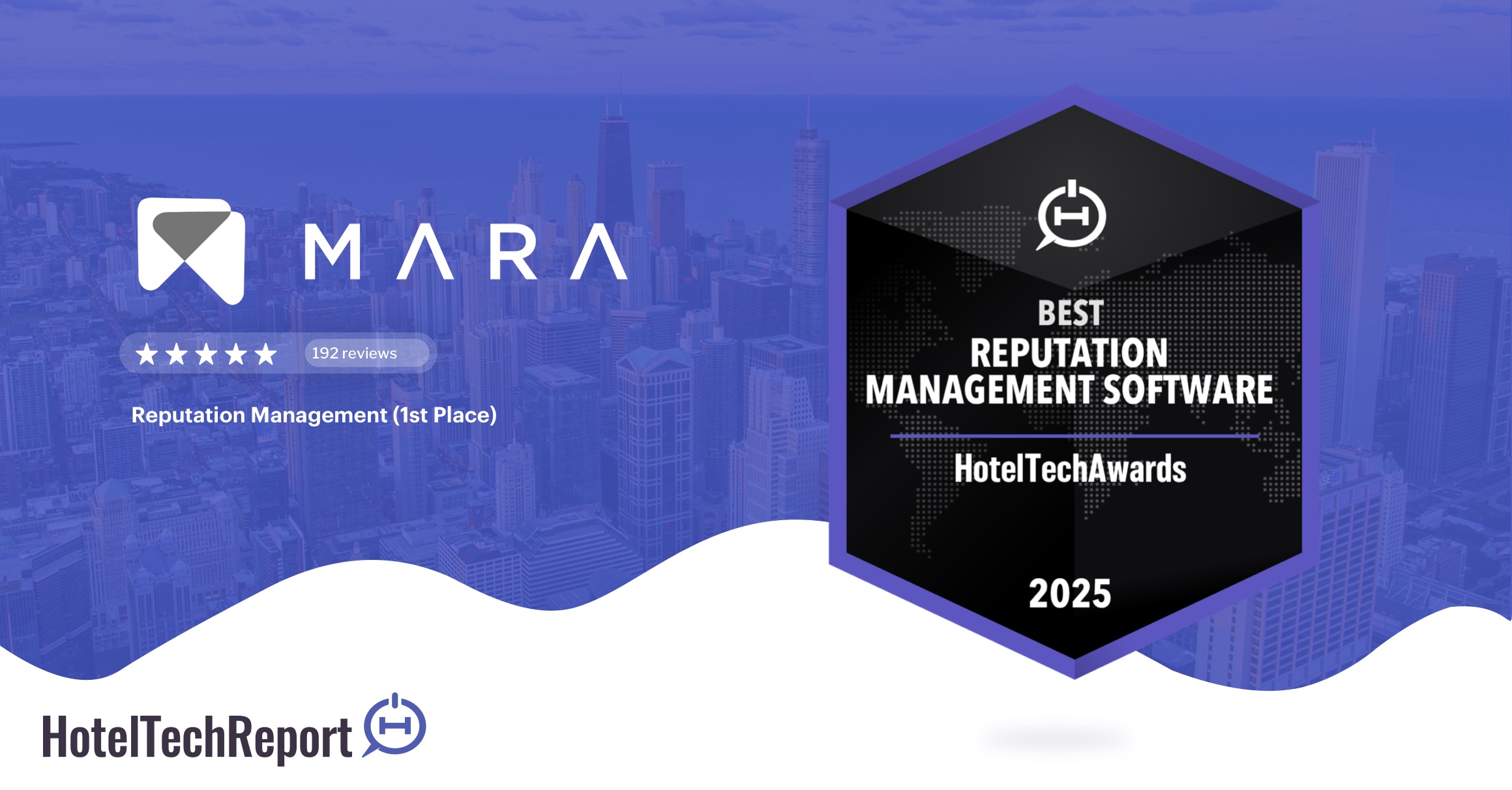
MARA is ranked #1 in reputation management on Hotel Tech Report, where it won Best Reputation Management Software in 2025 and 2026 and the Hoteliers' Choice Award. To see what your own reviews say about what to fix, Book a Demo with the MARA team.
{{blog-cta-book-demo="/features/product-updates"}}
MARA named the #1 Reputation Management Software for Hotels
.avif)
Questions hotels ask before starting
Everything worth knowing before your first reply.
Guest feedback intelligence is the practice of bringing together every piece of guest feedback and turning it into decisions. It runs from collecting feedback and understanding it at scale, through prioritising what affects your rating and acting on it, to identifying where to invest. Sentiment analysis is one part of it.
Yes. In MARA, post-stay survey responses run into the same analytics as OTA reviews, and you can filter to see reviews only, surveys only or both. Topic analysis uses the overall rating question and its comment. Answers to additional survey questions are analysed separately in each survey's own statistics. In-stay surveys are kept out of the overall analytics.
More is better, and Impact Scores are most meaningful for topics with a reasonable number of mentions. MARA generates an AI summary for any category or room once it has five or more reviews. For small properties, looking at a quarter rather than a month gives each topic enough data to trust.
No. Topic detection, Positivity Score and Impact Score work from review text and ratings alone. A PMS integration adds room number, room type, rate and stay dates, which enables room-level analysis, automatic service tickets and guest preference notes written back into the PMS.
MARA checks every connected platform for new reviews each morning at around 4 a.m., so topics, scores and trends reflect the previous day's reviews.
Still have questions?
Our team is happy to walk you through it.
Related Articles
Awards, guides, and what we are publishing for hotels.





















Ready to see your reviews answered for you?
Connect your reviews and watch MARA draft replies in your voice. Free to start.