

How to Measure AI Search Visibility for a Hotel Group (2026 Guide)

To measure AI search visibility for a hotel group, track a fixed set of guest-style prompts for every property across ChatGPT, Gemini, Perplexity and Google AI Overviews. For each hotel, measure how often AI mentions it (visibility), where it appears in the answer (position) and which hotels AI recommends instead. Compare the results over weeks, not single answers, and apply what you learn at one property across the whole group.
You can't manage what you can't measure. More and more guests ask ChatGPT, Gemini or Google where to stay before they ever open a booking site, and most hotel groups have no idea whether their properties are part of those answers. Measuring a group is harder than measuring a single hotel: every property competes in its own local market, sister hotels show up in each other's answers, and a brand-level number hides the properties that are slipping. This guide shows a step-by-step approach built for hotel groups.
In short:
- Track every property. Each hotel competes in its own local market, so every property needs its own prompts, score and competitors.
- Apply what you learn across the group. A fix that works at one property, such as a better website template or complete listings, usually helps the others too.
- Use guest-style prompts in the words guests actually type, with the right region.
- Track four platforms: ChatGPT, Gemini, Perplexity and Google AI Overviews.
- Read visibility and position together, and compare against the hotels AI actually recommends.
- Look at the sources behind every gap, because that is where the fix is.
{{cta-vt="/features/product-updates"}}
SEO vs. GEO: what's the difference?
SEO (search engine optimisation) helps your pages rank in search results so people click through to your website. GEO (generative engine optimisation) helps your hotel get mentioned and recommended inside AI answers. The two overlap, but they are measured differently.
Good SEO helps with GEO, because a clear, crawlable website is one of the sources AI reads. But a hotel can rank well in Google search and still be missing from AI answers if its listings and reviews tell AI too little. For the levers that improve AI visibility, see our guide to GEO for hotels.
Why hotel groups need to measure AI visibility differently
When a guest asks ChatGPT for a hotel near the old town with parking, the answer lists individual hotels, usually six to ten of them. That has three consequences for groups:
- Every property competes locally. Your city hotel competes with other hotels in its district, your resort with other hotels in its region. One group-wide score can't show that.
- Sister hotels count as competitors. If two of your properties are recommended for the same question, each one appears in the other's results.
- Many fixes are shared. Your website template, how your listings are maintained and which content is missing often apply to every property. What you learn at one hotel can be rolled out everywhere.
If you're new to the topic, start with what AI visibility tracking is and what it can't do.
The metrics that matter
How to measure AI search visibility for a hotel group, step by step
1. Track every property in its own local market
Each hotel in your group operates in its own local competition. Your city hotel competes with different hotels, for different guests and with different sources behind the AI answers than your resort or your airport hotel. That's why tracking every property pays off:
- Different competitors: the hotels AI recommends next to yours change from one location to the next.
- Different guests: business travellers, families and leisure guests ask different questions.
- Different sources: AI reads other listings, review sites and destination articles for each location.
- No hidden gaps: a group average can look fine while individual properties are missing from AI answers entirely.
Then prioritise where to act first: competitive markets and the properties where AI visibility matters most for your business.
2. Build guest-style prompts for each property
Your results are only as good as your prompts. Use the questions guests ask before they book, in their own words:
- Use guest language, not marketing language: "Which hotels in Cologne have a good breakfast?" instead of the brand name of your breakfast concept.
- Get the region right: a whole country is too broad, a single street too narrow. A district, a town or a well-known area works best.
- Skip features every hotel has, like free Wi-Fi, and features only you have. Choose features several hotels compete on, such as parking with EV charging, a spa or pet-friendly rooms.
- Track the business you want: if families are a key segment for a property, cover them.
Use the same structure across properties (destination, segment and need-based questions) so you can compare them later.
3. Track all four major AI platforms
ChatGPT, Gemini, Perplexity and Google AI Overviews each read different sources and often recommend different hotels. A property that does well on ChatGPT can be missing from Google AI Overviews entirely. Track all four and look at each one separately.
4. Measure trends, not single answers
AI answers change from one run to the next. A single check shows a snapshot, not your real position. Run every prompt repeatedly and look at visibility over a week or a month. Keep your prompt list stable: adding or removing prompts changes the score even when the AI answers stay the same.
5. Benchmark against the hotels AI actually recommends
Don't start with your revenue management competitive set. AI may recommend a small independent hotel or a hotel in the next district that you have never considered a competitor. Compare each property with the hotels that appear in its AI answers, and treat your own sister hotels as what they are: part of the group, not lost business.
6. Find the sources behind every gap
When a property is missing for a prompt, check which pages AI reads for that question and which hotels they mention. Typical causes are information missing from your Booking.com, Google, Tripadvisor or Expedia listings, pages that don't mention your hotel, website content that doesn't state what guests are looking for, and technical issues that make your website hard for AI to read.
7. Apply what you learn across the group
Many gaps are not local at all. A missing parking section on your website template, outdated listing facts or a family offer that is hard to find usually affects several properties at once. Fix the pattern everywhere, mark when each change went live, and check in each property's data whether it worked. Because every property is tracked, you see not only whether a fix helped, but where it helped most.
"The action plan is what impressed me most. It showed us, hostel by hostel, where our websites weren't clearly stating things we offer, so AI tools were leaving them out. Those were easy wins we hadn't spotted ourselves, and the platform made it easy to prioritise tasks and measure their impact quickly." Phill Burges, Head of Digital Marketing, beds & bars
What a hotel group report should show
Report per property first, then summarise for the group. An illustrative example:
The pattern in this example, missing practical facts on the website template and in listings, is exactly the kind of fix that pays off across the whole group.
How often to measure and review
- Continuously: let prompts run automatically so every score is based on many answers.
- Monthly: review each property, its biggest gaps and the sources behind them.
- Quarterly: roll out group-wide fixes and report the group trend to management.
Common mistakes
- Tracking only a few flagship properties. Every property has its own local competition, so gaps at untracked hotels stay invisible.
- Comparing scores after changing prompts. A new prompt list means a new baseline.
- Choosing a region that is too broad. Against hundreds of hotels, visibility stays close to zero and tells you little.
- Judging by single answers. One screenshot of ChatGPT is not a measurement.
- Tracking only ChatGPT. Guests also plan trips in Google, Gemini and Perplexity.
- Reporting one group-wide number. It hides the properties that need attention.
More questions hotel groups ask about AI visibility
How long does it take before changes show up in AI visibility?
It depends on where the fix happens. If AI already reads a page for your prompts, such as your website or an OTA listing, an update there can show up within days. A typical quick win: your Booking.com listing is read heavily by AI, but a facility is missing. Adding it can make a difference within days. Changing what AI models have learned about your hotel over time takes much longer, often months. That's why it pays to start with the sources AI already reads for your prompts.
Does good SEO mean good AI visibility?
Not automatically. A well-structured, crawlable website helps with both, but AI platforms also read listings, review sites and articles that mention hotels. A hotel can rank well in Google search and still be missing from AI answers if those sources describe it poorly or not at all.
Why do ChatGPT and Google AI Overviews recommend different hotels?
Each platform reads different sources and weighs them differently. A hotel can be strong on one platform and missing on another, which is why a hotel group should track all four major platforms separately.
Why does a score change when nothing changed at the hotel?
AI answers vary from run to run, competitors change their websites and listings, and AI platforms update their models. Changes to your prompt list also change the score. That is why trends over weeks matter more than single results.
Do reviews affect AI hotel recommendations?
Yes. Reviews are one of the sources AI platforms read when they recommend hotels, so ratings, review volume and what guests write all shape how AI describes a property. Read more in our article on how reviews affect AI hotel recommendations.
Which tool to use
Generic AI visibility tools can track any brand, but leave the prompts, the hotel competitors and the analysis to you. For hotel groups, a hotel-specific tool saves most of the work. We compared the options in our guide to the best AI visibility tools for hotels.
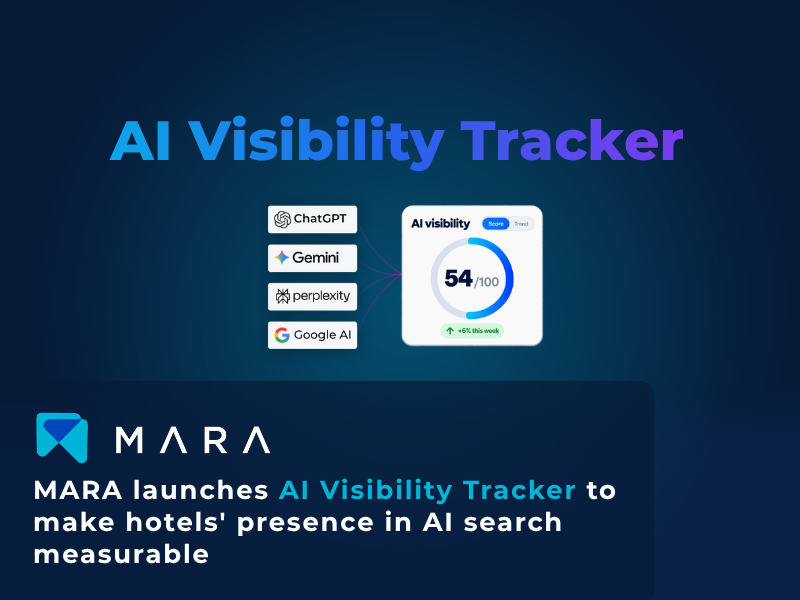
The MARA AI Visibility Tracker was built for this: it tracks ChatGPT, Gemini, Perplexity and Google AI Overviews per property, suggests guest-style prompts from your website and listings, detects the hotels AI recommends automatically and turns gaps into recommendations for your website and listings. Plans start at €70 per property per month, with a free 7-day trial. If you run several hotels, see how MARA works for hotel groups.
Start measuring this week
Set up your properties, write 20 to 30 guest-style prompts for each and track them across the four platforms for a month. You'll know which of your hotels AI recommends, who it recommends instead and which fixes apply to the whole group. You can't manage what you can't measure, and in AI search most hotel groups are still flying blind.
Start your free 7-day trial and see your first results in about 15 minutes.
MARA named the #1 Reputation Management Software for Hotels

Questions hotels ask before starting
Everything worth knowing before your first reply.
Track a fixed set of guest-style prompts for every property across ChatGPT, Gemini, Perplexity and Google AI Overviews. For each hotel, measure how often it is mentioned (visibility), where it appears in the answer (position) and which hotels AI recommends instead. Compare results over weeks rather than single answers, and apply what you learn at one property across the group.
There is no universal benchmark. A city hotel in a large city competes with many more hotels than a hotel in a small town, so a lower score can still be a strong result. The most useful comparison is with the hotels AI recommends for the same prompts.
Yes. Each hotel competes in its own local market, against different hotels, for different guests and with different sources behind the AI answers. A group average hides the properties that are missing. Tracking every property shows where each one stands, and fixes that work at one property can then be rolled out and checked at the others.
SEO helps your pages rank in search results so people click through to your website. GEO (generative engine optimisation) helps your hotel get mentioned and recommended inside AI answers from ChatGPT, Gemini, Perplexity and Google AI Overviews. SEO is measured with rankings and clicks, GEO with how often and how prominently AI names your hotel. They overlap, but AI also relies heavily on third-party sources such as listings and review sites.
Track continuously and review monthly. AI answers vary from run to run, so a score based on many answers over a week or a month is far more reliable than a single check. Keep your prompt list stable so results stay comparable over time.
Still have questions?
Our team is happy to walk you through it.