

What Is AI Visibility Tracking? Prompts, Scores and Limits Explained for Hotels (2026)

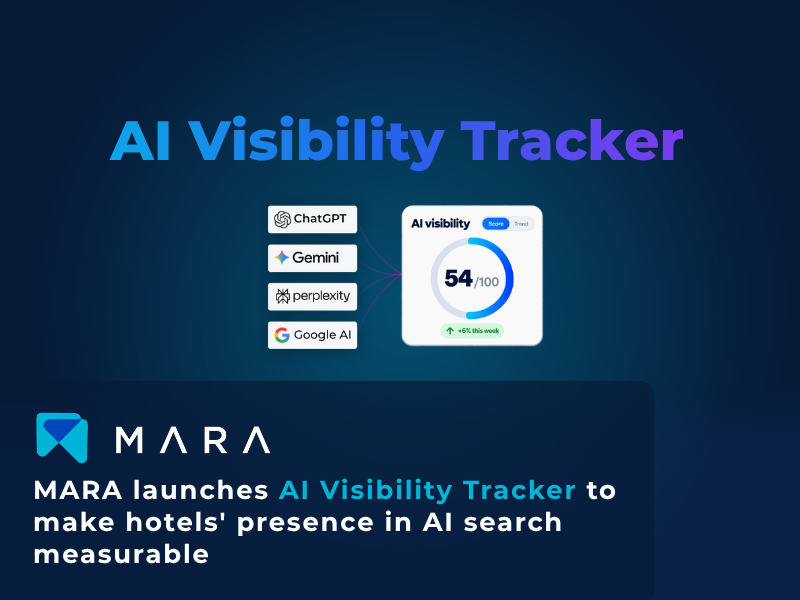
AI visibility tracking means asking AI platforms like ChatGPT, Gemini, Perplexity and Google AI Overviews the questions your guests ask, again and again, and measuring how often your hotel is recommended. The result is your AI visibility score. Tracking also shows who is recommended instead and which websites the answers come from. It can't tell you how many guests asked those questions.
In short:
- AI visibility tracking is built on three terms: prompt, chat and visibility score.
- Your AI visibility score is the share of chats in which your hotel is recommended.
- Tracking also shows your competitors, the sources behind each answer and what AI gets wrong about you.
- Its limits: the questions are chosen by you, there's no search volume, and answers change from run to run.
- It's still the only data on the moment AI puts hotels on a guest's shortlist.
{{cta-vt="/features/product-updates"}}
What is AI visibility tracking?
AI visibility tracking measures how often AI platforms recommend your hotel when guests ask for a place to stay. It's built on three terms:
- Prompt: a question a guest might ask an AI platform, for example "What are the best family-friendly hotels in Hamburg?"
- Chat: every prompt runs on several platforms, like ChatGPT, Perplexity, Gemini and Google AI Overviews. One prompt on one platform is one chat.
- Visibility score: the share of chats in which your hotel is recommended.
How is an AI visibility score calculated?
Say you track 30 prompts once a week on 4 platforms. That's 30 × 4 weeks × 4 platforms = 480 chats per month. If your hotel is recommended in 96 of them, your AI visibility score is 20%.
The score only means something with the same set of prompts over time. Change the prompts and the score changes, even if nothing about your hotel did.
What does AI visibility tracking show besides your score?
- Whether you make the shortlist for the questions that matter to you.
- Who is recommended instead. Every hotel named in the answers is identified, so you see how often competitors are recommended for the same prompts.
- Why they win. The sources behind each answer: a competitor's parking page, a city guide, Booking.com reviews. That becomes your to-do list.
- What AI gets wrong about you, like old prices, a closed spa or outdated details.
What does that look like in practice?
Take the prompt "What are the best city hotels in Hamburg with free parking and an EV charging station?" Your hotel isn't recommended. The top recommended hotels all have one thing in common: a dedicated page about parking and charging, and that page is cited in the answers. That's a clear signal to build a similar page.
Our guide on why your hotel isn't showing up in ChatGPT covers this and six other common reasons.
What are the limits of AI visibility tracking?
Tracking has three real weaknesses, and you should know them before you rely on it:
- The questions are synthetic. You or the tool choose them. They're not what real guests actually typed.
- There's no volume. You see whether your hotel appears, but not how many people asked. AI platforms don't publish prompt volume.
- Answers change all the time. Ask the same question twice and you may get two different hotels. One snapshot means little, so prompts need to run regularly and you watch the trend.
You can reduce the first weakness. Build your prompts from questions guests really ask: emails to your reservations team, topics in your reviews, questions at the front desk.
Why track AI visibility if AI bookings look small?
Because a lot of AI-influenced bookings never show up as such in your analytics. Picture a guest who asks ChatGPT for hotel ideas, then compares prices on Booking.com, reads reviews on Tripadvisor, and finally googles your hotel and books direct. Google Analytics credits that booking to Google. The moment ChatGPT put you on the shortlist, or didn't, isn't recorded anywhere.
Last-click numbers are small for now. Booking Holdings has said that AI assistants bring well under 1% of its room nights. That doesn't capture AI's influence earlier in the journey. Tracking the prompts guests ask is the only data on that part of it.
How do you start tracking your hotel's AI visibility?
- Write down 20 to 30 questions your guests really ask, across location, guest types and specific needs.
- Run them regularly on the platforms your guests use, starting with ChatGPT.
- Look at the sources before the score: they tell you what to fix.
- Change a few things at a time and watch the trend over weeks, not days.
For the full set of levers, read our guide to GEO for hotels.
If you'd rather not run this by hand, the AI Visibility Tracker from MARA does it for you. Full disclosure: we build it, which is exactly why we think you should know what tracking can't do.
Start your 7-day free trial and see in 15 minutes whether AI platforms recommend your hotel.
{{cta-vt="/features/product-updates"}}
MARA named the #1 Reputation Management Software for Hotels

Questions hotels ask before starting
Everything worth knowing before your first reply.
There's no universal benchmark. It depends on your prompts, city and competition. Compare yourself with the hotels recommended for the same prompts and watch your trend.
Usually 20 to 30 well-chosen questions are enough to start, covering your location, your main guest types and your key features.
You can check single questions, but answers vary between runs and depend on your location and chat history. Reliable tracking needs many repeated runs.
No. AI platforms don't publish prompt volume, so tracking shows whether you appear, not how often a question is asked.
At least weekly. Answers change from run to run, so the trend over several weeks matters more than any single result.
Still have questions?
Our team is happy to walk you through it.