

GEO for Hotels in 2026: How to Get Your Hotel Recommended by ChatGPT and AI Search


GEO (generative engine optimization) for hotels means making sure AI platforms like ChatGPT, Gemini, Perplexity and Google AI Overviews find, read and trust the right information about your hotel, so they recommend it when guests ask where to stay.
More and more travellers start their search with a question like "Which hotels in Cologne are good for families?" instead of a list of links. The AI answers with a short list of hotels. If your hotel isn't on that list, the guest may never consider it. That makes AI visibility the next chapter of online reputation management for hotels: guests still recommend hotels to each other, but now AI does too.
This guide is based on what we learned while tracking AI answers for hotels, hostels and hotel groups in our beta programme. It explains how AI platforms choose hotels, what they read, and what you can do about it.
In short:
- AI platforms search the web, read a handful of sources and recommend usually 6 to 10 hotels per answer.
- Your hotel is only recommended if the specific fact a guest asks about sits on a page the AI actually reads.
- Booking.com and other listings are read more often than most hotel websites.
- Questions about specific needs, like parking or pet-friendly rooms, are the easiest to win.
- Start by fixing the pages AI already reads, then build simple pages for specific needs.
{{cta-vt="/features/product-updates"}}
How do AI platforms decide which hotels to recommend?
When a guest asks an AI platform for a hotel recommendation, the answer doesn't come from a fixed ranking. The platform runs a web search, reads a handful of sources and builds a short list from what it finds. Researchers describe this shift in the paper GEO: Generative Engine Optimization, which coined the term.
- The guest asks a question, for example "Which hotels in Salzburg have their own parking?"
- The AI searches the web and picks pages that look relevant and trustworthy: booking sites, review sites, travel guides, hotel websites.
- It reads those pages and looks for hotels that match the question.
- It answers with a list, usually between 6 and 10 hotels, often with a short reason for each.
Two things follow from this. First, information about your hotel only helps if it sits on a page the AI actually reads. Second, the AI needs to find the specific fact the guest asked about. If your Booking.com listing doesn't mention parking, you won't be recommended for parking, even if you have 200 spaces.
What types of questions do guests ask AI?
Not every question is equally hard to win. In our tracking, guest questions fall into three types:
- Destination Discovery: a type of hotel in a place, for example "What are the best boutique hotels on Lake Tegernsee?" These are the hardest to win, because big OTAs and well-known hotels dominate.
- Segment-specific: a hotel for a type of guest, for example "Which hotels in Erfurt are good for families?" These are medium difficulty.
- Need-based: a hotel with a specific feature, for example "Which hotels in Cologne have parking with EV charging?" These are the easiest to win, because few pages answer them well.
Broad questions get the most attention but are dominated by booking sites and big brands. Specific needs and guest segments are where independent and smaller hotels have the best chance to be recommended, often within weeks.
What does each AI platform read?
Each AI platform searches the web in its own way and prefers different sources. That's why a hotel can be recommended by ChatGPT and be missing from Google AI Overviews for the very same question. These are the patterns we see most often in our data:
- ChatGPT: hotel websites, alongside booking sites
- Google AI Overviews: Google's own sources, such as Google Business Profiles and YouTube
- Gemini: booking sites, travel guides and blogs
- Perplexity: booking sites, review sites, travel guides and blogs
Two more observations:
- Booking.com is the most cited source overall. Across hotels, it's usually read more often than any hotel's own website.
- Hostels are different. For hostels, AI platforms rely much more on travel blogs, guides and forums, and less on property websites.
These preferences shift whenever a platform updates its model or its search. Treat them as a starting point and check what the platforms read for your own hotel.
If you can only focus on one platform, start with ChatGPT. It's by far the most widely used AI platform among travellers, and its search feature pulls in live web results.
How can you get your hotel recommended by AI?
1. Complete and align your listings
AI platforms read your Booking.com, Google, TripAdvisor and Expedia listings more often than your own website. In many chats where a hotel wasn't recommended, the AI had read its listing but couldn't find the feature the guest asked about.
- Tick every amenity that applies in the Booking.com Partner Hub and your Google Business Profile, such as parking, EV charging, pet-friendly rooms or a gym.
- Keep facts identical everywhere: name, address, phone number, number of rooms.
- Remove outdated details, like a former brand name that still shows up as an alias.
Consistent facts help AI platforms trust that every source describes the same hotel. Contradicting facts do the opposite.
Our guides to optimizing your Booking.com profile, optimizing your Google Business Profile and optimizing your Tripadvisor listing walk you through each platform step by step.
2. Put key facts on your main hotel page
Your main hotel page is the page AI platforms read most often on your website. If guests care about something, it belongs there, not only on a sub-page. One hotel we tracked had an underground garage with 600 spaces and 24 EV chargers, but the information sat on a page AI rarely read.
3. Build simple pages for specific needs
One city hotel in Salzburg was recommended for almost no specific needs, with one exception: parking. The reason was a plain landing page about parking, listing the number of spaces, prices and EV chargers. AI platforms read it again and again.
The same works for families, solo travellers, conferences, pets or neighbourhood guides. Plain text with concrete facts is enough. Pages like these face little competition and are often picked up quickly.
4. Make your FAQ readable for AI
Many hotels have a FAQ, but AI platforms never see it. Common reasons:
- The FAQ sits on a separate page that's only linked from the footer.
- The answers only load with JavaScript, so AI sees the questions but not the answers.
Add a FAQ section to your main hotel page instead, for example collapsed at the bottom, and mark it up as FAQPage structured data.
5. Add structured data (schema markup)
Structured data is invisible to guests but describes your hotel in a machine-readable format, usually based on the schema.org Hotel type. Check that it includes:
- the hotel type, full address, phone number and number of rooms
- your amenities, without marking amenities you don't have as "false" by default
- links to your listings (sameAs), so AI can connect them to your website
- no leftover placeholder text
Structured data helps AI platforms trust your facts. On its own, it rarely changes your visibility, so treat it as a foundation rather than a quick win.
6. Get mentioned on the pages AI reads
For many questions, AI platforms read travel guides, blogs, directories and tourism websites. If a page is read often for your target questions but doesn't mention your hotel, it's worth getting listed there, through a free listing, a partnership or a friendly email to the author. This takes more effort, so start with the pages that come up across many questions.
What can't hotels influence in AI search?
Some results are hard to change, whatever you do:
- Pages sorted by distance. For questions like "hotels near the Cologne trade fair", AI platforms often read Booking.com pages that list hotels by distance to a landmark. A hotel 1.6 km away won't beat one 350 m away there.
- Text you can't edit. Booking.com generates its own description text. You can tick facilities, but you can't rewrite the description freely.
- Natural variation. AI answers change from one run to the next, even for the same question. A single check in ChatGPT tells you little.
Knowing this saves effort: focus on the questions you can actually win and that bring the guests you want.
Where should hotels start with GEO?
Work in this order:
- Fix the pages AI already reads. Updates to your listings and main hotel page can show an effect quickly, because AI platforms read these pages all the time.
- Build pages for specific needs and guest segments where competitors are recommended and you aren't.
- Get mentioned on third-party pages that are read across many of your target questions.
Make a few changes at a time and watch what happens. If you change ten things on the same day, you won't know which one made the difference.
What is the difference between GEO and SEO for hotels?
GEO builds on SEO for hotels rather than replacing it. AI platforms use web search to find their sources, so pages that rank well in search engines are more likely to be read. Submitting new pages in Google Search Console helps them get found faster.
What changes is the goal. In SEO, you want a click on your link. In GEO, you want to be named in the answer, which also depends on what other websites, like booking sites and travel guides, say about you. And unlike SEO, there is no search volume: AI platforms don't publish how often a question is asked.
How do you measure your hotel's AI visibility?
You can't improve what you don't measure, and asking ChatGPT yourself once in a while isn't enough. Answers vary from run to run and depend on your location, language and previous conversations.
Reliable measurement needs three things:
- A fixed set of realistic guest questions, covering all three question types and written the way guests ask them.
- Repeated runs on every platform, so your visibility is based on many answers instead of a single snapshot.
- The sources behind each answer, so you can see why competitors are recommended and you aren't.
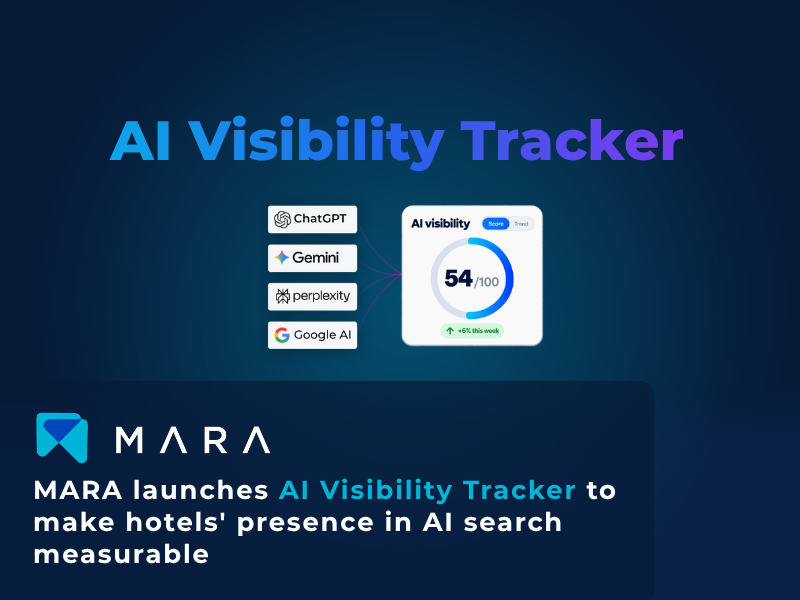
The MARA AI Visibility Tracker does exactly this. It runs your questions on ChatGPT, Gemini, Perplexity and Google AI Overviews, shows how often your hotel is recommended compared with your competitors, which pages AI platforms read, and what to change to be recommended more often.
Start your 7-day free trial and see in 15 minutes whether AI platforms recommend your hotel.
{{cta-vt="/features/product-updates"}}
MARA named the #1 Reputation Management Software for Hotels

Questions hotels ask before starting
Everything worth knowing before your first reply.
GEO (generative engine optimization) is the work of making sure AI platforms like ChatGPT, Gemini, Perplexity and Google AI Overviews find and trust the right information about your hotel, so they recommend it to guests.
No. GEO builds on SEO, because AI platforms use web search to find their sources. Good SEO makes it more likely that AI reads your pages.
No. AI answers are organic. Google Ads or other paid placements don't influence which hotels ChatGPT or Gemini recommend in their answers.
Changes to pages AI already reads often, like your Booking.com listing or main hotel page, can show an effect within days. New pages usually need to be found by search engines first, which can take a few weeks.
ChatGPT is by far the most widely used AI platform among travellers, so it's the best place to start.
Still have questions?
Our team is happy to walk you through it.