

7 Best AI Visibility Tools for Hotels in 2026

Last updated: November 2026
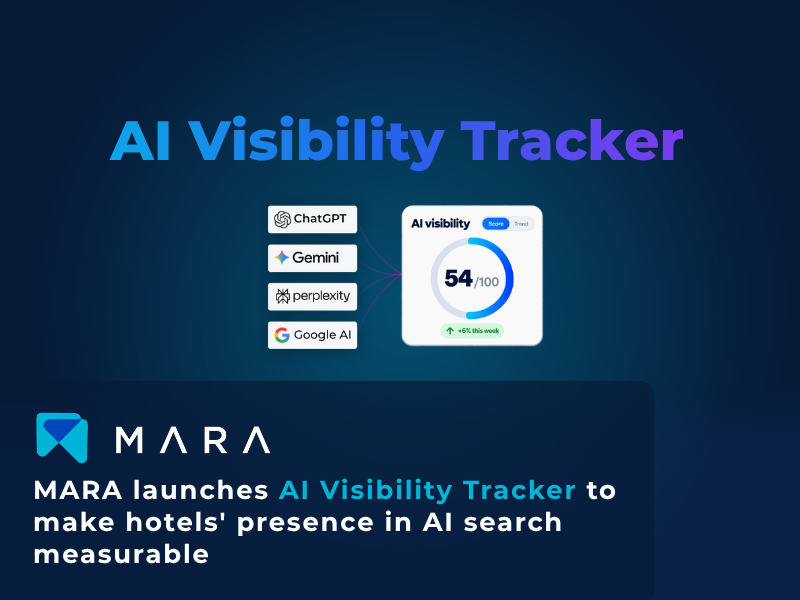
The best AI visibility tool for hotels in 2026 is the MARA AI Visibility Tracker, followed by Hotelrank, RevPAR Genius, Peec AI, Otterly.AI, Semrush and Profound. MARA is the only one built from the ground up for hotels, with tracking across ChatGPT, Gemini, Perplexity and Google AI Overviews and recommendations based on what a hotel can actually change.
Hotels don't need another visibility score. They need to know whether ChatGPT, Gemini, Perplexity and Google AI Overviews recommend them, who gets recommended instead, and what to change so that next month's answer looks different. Most AI visibility tools are built for brands in general and do the first part well. Very few understand what a hotel can actually change.
If you're new to the topic, start with what AI visibility tracking is and what it can't do.
In short:
- MARA AI Visibility Tracker is the best choice for most hotels and hotel groups: built for hotels, with recommendations based on the pages AI actually reads.
- Hotelrank, now part of Lighthouse, suits hotels that already use Lighthouse.
- RevPAR Genius is a hotel-specific starting point with a free report.
- Peec AI is a very solid tool for brands outside hospitality, and Otterly.AI a low-cost generic tracker.
- Semrush fits marketing teams that already work in Semrush.
- Profound is built for enterprise brands with large budgets.
AI answers change between runs, platforms and locations, so every tool here measures a trend, not a fixed ranking.
{{cta-vt="/features/product-updates"}}
How we compared these tools
We build the MARA AI Visibility Tracker, and we use and test other AI visibility tools in our own marketing and in our work with hotels, hostels and hotel groups. We compared all seven on four criteria that matter for hotels: how well they fit a hotel's questions and competitors, which AI platforms they cover, how clear their pricing is, and how directly they turn a visibility gap into a task a hotel team can do. Prices and features were checked in November 2026.
Comparison of the best AI visibility tools for hotels
1. MARA AI Visibility Tracker: best for hotels that want to know what to fix
The MARA AI Visibility Tracker is the only tool in this list built from the ground up for hotels. Think of it as Peec AI or Profound for hotels: the same top-notch tracking across ChatGPT, Gemini, Perplexity and Google AI Overviews, but with recommendations built for what a hotel can actually change.
It starts with the prompts. When you set up a property, MARA analyses your website and listings and suggests the questions real guests ask before booking, like "Which hotels in Salzburg have their own parking?" You can edit, add and remove them at any time. MARA automatically detects every hotel named in the answers, so you see your real AI competitors without setting up a competitive set by hand.
The bigger difference is that MARA knows hospitality. It knows what you can and can't change on platforms like Booking.com or Google, and which levers move a hotel's AI visibility most. Generic tools stop at "you're not visible for this prompt". MARA looks at your prompts with the lowest visibility, checks which hotels win them and which pages AI reads, then reviews your website and your listings on Google, Booking.com, Tripadvisor and Expedia. Every recommendation falls into different types, such as:
- Listings: information missing or outdated in listings AI reads often.
- Citation gaps: pages AI reads for your prompts that don't mention your hotel.
- Content gaps: information guests look for that your website doesn't state clearly.
- Technical: issues that make your website harder for AI to read.
Each recommendation says what to do, which prompts it affects and why, and often includes ready-to-use text for your website or listing. They're refreshed monthly and move through a to-do board, and completed tasks show up on your visibility charts, so you can see whether a change worked. That's the part a hotel team can act on without an SEO agency.
"The action plan is what impressed me most. It showed us, hostel by hostel, where our websites weren't clearly stating things we offer, so AI tools were leaving them out. Those were easy wins we hadn't spotted ourselves, and the platform made it easy to prioritise tasks and measure their impact quickly."
Phill Burges, Head of Digital Marketing, beds & bars
The tracker is a standalone product. Hotels that also use MARA for reputation management see both in one account, which matters because reviews are one of the strongest signals in AI hotel recommendations, as recent research on reviews and AI recommendations shows.
MARA pricing
Every account starts with a free 7-day trial: MARA runs all your prompts once on every platform, and your first results and recommendations appear within about 15 minutes. Paid plans start at €70 per property per month, track prompts continuously and refresh recommendations every month.
Prices checked in November 2026.
MARA review signal
The AI Visibility Tracker launched in October 2026, so independent reviews are still building. MARA as a company was voted the #1 reputation management solution in the 2025 and 2026 HotelTechAwards, based on verified hotelier reviews.
Who should choose MARA?
Choose MARA if you run an independent hotel or a hotel group and want more than a score: a clear list of what to change on your website and listings, prioritised by the prompts it affects. Hotel groups don't need to track every property from day one; starting with a few key properties is usually enough to find patterns that apply across the portfolio.
2. Hotelrank: best for hotels already using Lighthouse
Note: Hotelrank.ai was acquired by Lighthouse in May 2026 and is now part of Lighthouse's Connect AI. We list it under its original name because many hoteliers still search for it that way.
Hotelrank was one of the first AI visibility tools built specifically for hotels. Founded in France in 2025, it measures how hotels appear in AI platforms such as ChatGPT and Gemini, with an AI visibility score, how AI describes a hotel compared with its competitors, and whether AI answers send travellers to the hotel's own website or to an OTA. That last point is a useful angle for revenue and distribution teams.
Inside Lighthouse, Hotelrank is now the measurement layer of Connect AI, which focuses on making hotels discoverable and bookable through AI platforms. That makes it a natural fit for hotels already working with Lighthouse for rate intelligence or distribution, and less of a standalone choice for everyone else.
Hotelrank pricing
Pricing isn't published. Since the acquisition, hotels get Hotelrank's analytics as part of Lighthouse Connect AI, so the cost depends on your Lighthouse package.
Checked in November 2026.
Who should choose Hotelrank?
Choose Hotelrank if you already use Lighthouse and want AI visibility in the same platform as your rate and distribution data. If you want a standalone tool with concrete fixes for your website and listings, compare it with MARA.
3. RevPAR Genius: best for a first hotel-specific baseline
RevPAR Genius is a hotel-focused AI visibility service. It tests traveller-style questions, measures how often and at which position a hotel is mentioned, shows the sources behind the answers and compares the hotel with competing properties. Its research is also widely quoted in the industry, including the finding that only around 6% of hotels appear in AI search at all.
The easiest way in is the free Hotel AI Visibility Report, which gives a one-off baseline with little setup. Recommendations cover areas like reviews, citations, website content and structured property information. What's harder to judge is the paid product: capacity, property limits and update frequency aren't published, so a hotel group needs a sales conversation before it can compare costs.
RevPAR Genius pricing
The Hotel AI Visibility Report is free. Paid plans aren't published, so ask for property limits, prompt volume, update frequency and exports before you buy.
Checked in November 2026.
Who should choose RevPAR Genius?
Use the free report if you want a quick, hotel-specific snapshot. For continuous tracking with transparent pricing and a self-service trial, compare it with MARA.
4. Peec AI: a very solid tool for brands, less suited to hotels
Peec AI is one of the best generic AI visibility tools on the market. It tracks visibility, position and sentiment across AI platforms every day, its source analysis goes down to individual URLs, and its interface is among the cleanest in the category. All plans include unlimited users.
For hotels, though, you quickly run into problems. Peec's recommendations are written for brands in general, so they don't fit what a hotel can actually change, like the facts on a Booking.com listing or a missing parking page. You also have to add every competing hotel to your competitive set by hand, for every property you track. Prompts run per country rather than per city, which makes local hotel competition harder to read.
Peec AI pricing
Starter costs $95 per month for 50 prompts, three AI models and one project. Pro costs $245 per month for 150 prompts and two projects, and Advanced $495 per month for 350 prompts and five projects.
Prices checked in November 2026.
Peec AI review signal
G2 lists Peec AI at 4.7 out of 5. Reviewers praise the interface and competitor comparisons; some find the suggested prompts overlap and the recommendations not tailored enough.
Who should choose Peec AI?
For brands outside hospitality, Peec AI is our top pick. For hotels, it only makes sense if your marketing team is happy to build its own prompt sets and competitor lists and to translate generic recommendations into hotel tasks itself.
5. Otterly.AI: best for testing one property on a small budget
Otterly.AI runs your prompts every day on ChatGPT, Google AI Overviews, Perplexity and Microsoft Copilot, and scores how often your brand appears, in what tone and with which cited links. It also includes a GEO audit that checks whether AI crawlers can access your website. At $29 a month it's the cheapest way in.
The entry plan's 15 prompts are enough for a first test, for example your location, two or three guest types and a few key amenities. They run out quickly once you add competitors' strongholds or a second property. Gemini and Google AI Mode cost extra, which matters for hotels, because many guests plan trips inside Google.
Otterly.AI pricing
Lite costs $29 per month for 15 prompts and four AI platforms. Standard costs $189 per month for 100 prompts, and Premium $489 per month for 400 prompts.
Prices checked in November 2026.
Otterly.AI review signal
G2 lists Otterly.AI at 4.7 out of 5. Users like the quick setup and citation monitoring; criticism covers refresh delays and how hard it is to connect visibility to business results.
Who should choose Otterly.AI?
Choose Otterly.AI if you run a single hotel, want a low-cost daily log of AI answers and are happy to work out the fixes yourself.
6. Semrush: best for teams already working in Semrush
Semrush is the SEO platform many hotel marketing teams and agencies already use, and its AI Visibility Toolkit adds AI search to the same account. It gives a brand-level AI visibility score, shows which competitors appear for the same topics, suggests prompts to track and tracks them day by day. The big advantage is having SEO and AI visibility data side by side.
The toolkit is built for SMBs, agencies and mid-market companies in general, not for hotels. Tracking is organised by domain, which works for a single hotel website but gets expensive for a hotel group with a separate domain per property. And like the other generic tools, it shows where you're missing without telling you what to change on your Booking.com listing or room pages.
Semrush pricing
The AI Visibility Toolkit costs $99 per month and doesn't include a free trial. Each additional domain costs $99 per month, and 50 extra tracked prompts cost $60 per month.
Prices checked in November 2026.
Who should choose Semrush?
Choose Semrush if your team or agency already lives in Semrush and wants AI visibility as one more report next to rankings and traffic.
7. Profound: best for enterprise brands with large budgets
Profound is the enterprise heavyweight of AI visibility. It combines answer monitoring across AI platforms with citation analysis, crawler and referral analytics, AI agents that draft and report, and enterprise controls like SSO and SOC 2 compliance. Its standout feature is Prompt Volumes, which estimates how often topics come up, based on licensed and anonymised conversation data. The estimates are directional, not exact counts of what travellers type.
For hotels, Profound has the same problem as Peec AI: it isn't built for hospitality. Recommendations are generic and don't fit what a hotel can actually change, and every competing hotel has to be added to the competitive set by hand. On top of that, it's expensive: the entry plan covers ChatGPT only, and broader platform coverage means $399 per month or custom enterprise pricing.
Profound pricing
Starter costs $99 per month with annual billing and typically covers ChatGPT and 50 prompts. Growth costs $399 per month and adds platforms and capacity. Enterprise pricing is custom.
Prices checked in November 2026.
Profound review signal
G2 lists Profound at 4.5 out of 5 across more than 1,000 reviews. Reviewers praise cross-platform visibility and support; criticism covers price, interface density and limited report customisation.
Who should choose Profound?
Choose Profound if you're a large enterprise brand outside hospitality that needs demand estimates, governance and enterprise reporting, and has a team to work with the data. Hotel brands get hotel-specific recommendations from MARA at a fraction of the price.
Which tool fits an independent hotel or a hotel group?
Independent hotels need a tool that does the analysis for them. MARA fits best here: prompts are suggested from your website and listings, competitors are found automatically, and the recommendations come as tasks. Otterly.AI is the cheapest generic alternative if you want to do the analysis yourself, and RevPAR Genius's free report is a quick snapshot.
Hotel groups need to compare properties and spot patterns across the portfolio. MARA lets you start with a few key properties and roll out what works. Hotelrank is the obvious choice if the group already runs on Lighthouse. Peec AI suits groups with a central marketing team that wants to build its own analysis.
Large hotel brands get the same hotel-specific tracking and recommendations from MARA across as many properties as they need. Profound only makes sense if enterprise governance and demand estimates matter more than hotel-specific recommendations, and Semrush if the brand's SEO already runs on it.
Whichever tool you pick, check four things before you buy:
- Does it understand hotels? Guest-style prompts and hotel competitors, not generic brand keywords.
- Does it check your listings? Booking.com, Google and Tripadvisor are often read more by AI than your own website.
- Does it tell you what to change? A score that drops from 40 to 32 is only useful if you know what to fix next.
- What does it really cost per property? Prompts, domains, platforms and add-ons add up quickly for a group.
For the fixes themselves, our guide to GEO for hotels covers the seven levers that get hotels recommended.
Not a hotel? The best AI visibility tools for other businesses
If you're reading this from outside hospitality, the hotel-specific tools above aren't for you. Our pick for most brands is Peec AI: it has the cleanest interface in the category, advanced agentic features and a team that ships new capabilities quickly. Profound is the alternative for large enterprises that need governance, security and estimated topic demand, and have the budget for it.
Pick the tool your team will act on
A visibility score only pays off when someone changes something because of it. For most hotels, that means a tool that already knows what a hotel can change: the facts on your Booking.com listing, a missing parking page, a family offer your website barely mentions. That's why we built the MARA AI Visibility Tracker the way we did, and why it's first on this list.
You can see your own results in about 15 minutes. Start your free 7-day trial and find out whether ChatGPT, Gemini, Perplexity and Google AI Overviews recommend your hotel, and what to do if they don't.
MARA named the #1 Reputation Management Software for Hotels
Questions hotels ask before starting
Everything worth knowing before your first reply.
For most hotels and hotel groups, the MARA AI Visibility Tracker. It's built for hotels, covers ChatGPT, Gemini, Perplexity and Google AI Overviews, and turns visibility gaps into concrete recommendations for your website and listings. Hotels already using Lighthouse can use Hotelrank, and large enterprise brands may prefer Profound.
Entry prices range from $29 per month for a small generic tracker to several hundred dollars per month for enterprise platforms. MARA starts at €70 per property per month after a free 7-day trial. For hotel groups, check how prompts, domains and extra AI platforms are billed, because those drive the real cost.
Generic tools track any brand and leave the prompt set, competitors and analysis to you. Hotel-specific tools use guest-style questions, find competing hotels automatically and focus on the sources AI reads for hotels, like Booking.com, Google and Tripadvisor listings.
No. AI answers change between runs, platforms and locations, and no tool controls them. A good tool shows where you stand, why competitors win and what to change, then measures whether those changes moved your visibility.
Start with ChatGPT, the most widely used AI platform among travellers. Then add Google AI Overviews and Gemini, because many guests plan trips in Google, and Perplexity, which cites its sources clearly.
Still have questions?
Our team is happy to walk you through it.